
25+ Years of Surgical Excellence
650+ Successful Cochlear & Brainstem Implants
6,000+ Rhinoplasty & ENT Procedures
DO YOU HAVE ANY QUESTION?
COCHLEAR IMPLANTS

What is the need for Cochlear Implantation?
Deep deafness of perception are, in general, a result of cochlea deficiency located in the inner ear. In a normal hearing state, the cochlea transforms the mechanical vibrations transmitted from the ear drum and the chain of bones to a chain of electric signals to the brain through the auditory nerve. The rehabilitation of deep deafness is possible after a cochlea implant which will allow an electric stimulation directly from the auditory nerve interpreting auditory sensations.
How is the Cochlear Implantation operation done?
The surgeon places the internal part of the implant in an osseous lodge inside the temporal bone or on the surface of the bone along with 2 screws. The electrodes are inserted in the cochlea. The operation requires around 2 hours and needs general anesthesia.
Indications
Children starting 1 year (congenital) or adults suffering from bilateral or acquired deep auditory deficiency:
COCHLEAR IMPLANTS
Description of the device
The implant is composed of an external and an internal part.
The internal part
The implant is a small box placed behind the ear and under the skin surgically. It receives information from an external processor and distributes it through a group of electrodes inserted in the cochlea. Similar to the key pads of piano, each electrode corresponds to a frequency band of sound signals (bass and treble).
The external part
The processor is a small box or ear contour that treats ambient sounds captured by a microphone and placed on the pavilion of the ear. The sound signal is digitalized and treated by the micro-processor. Information is transmitted to the implant, through the skin, with the help of an antenna hidden in the hair. The processor uses a rechargeable battery.
COCHLEAR IMPLANTS
The Cochlear Implantation Operation
The surgeon places the internal part of the implant in an osseous lodge inside the temporal bone. The electrodes are inserted in the cochlea. The operation requires 2 hours and needs general anesthesia
Following up the implant:
Three weeks to one month after the surgical operation, the programming of the vocal processor (external part of the implant) is conducted with the help of a micro-computer.
For every electrode, a minimum and a maximum intensity of simulation will be predetermined. All these information shall be recopied to the device memory and constitute the dynamic gain of the patient at a given time.
This adjustment will be modified regularly depending on different variations that occur during the first months and require adaptation from the central nervous system.
The complementary cooperation between the 2 teams, surgical and educational, is essential.
Their role after the implantation is:
- to allow a good adaptation of the implant
- to assure a medical and technical follow up
- to meet and discuss the patient’s case
- to elaborate a cooperation among the patient, his/her family, medical, and educational team
The re-education of intensive speech therapy is oriented towards an auditory education, discrimination, evaluation of speech perceptions, and oral language perfection.
Parents play an important role in the acquisition of the oral language and they are a major element in the success of the project.
BEFORE & AFTER
Experience the transformation where expert surgical sculpting meets natural beauty. Dr. Wanna replaces structural disharmony with aesthetic refinement, restoring both your breathing and your confidence.


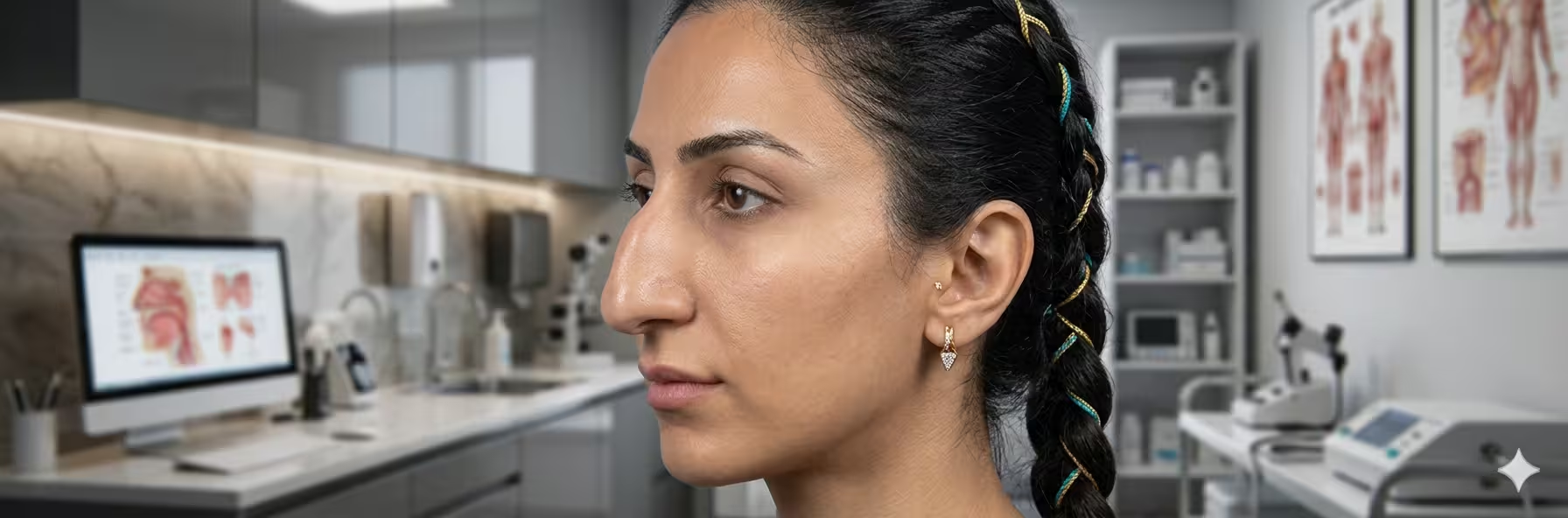
A Global Standard in ENT Treatments
WORKING HOURS
MON – FRI 9H00 – 16H00 PM
VISIT US
LEBANON, BSALIM, MIDDLE EAST INSTITUTE OF HEALTH (MEIH)
BOOK AN APPOINTMENT
00961-70997099